Blog
What we expected from Sarvam, and what true ‘sovereignty’ expects of us
#SarvamBacklash has been one of the most discussed topics in Indian technology and AI circles over the past few days.
The majority of what has been said is critical, and some in support of Sarvam.
While there have been varied opinions, not all seem to be with the right understanding of how Sarvam is judged. Nor such opinions consider the practical challenges of running a business.
Much of what I have written here comes from my lived experience of building language technologies for India for 20+ years.
I have seen how India's language technologies in the digital world have evolved, the challenges it continues to face, and the gap between technological ambition and what is required to deliver such outcomes.
So when #SarvamBacklash began trending, I felt the verdicts were arriving faster than the facts.
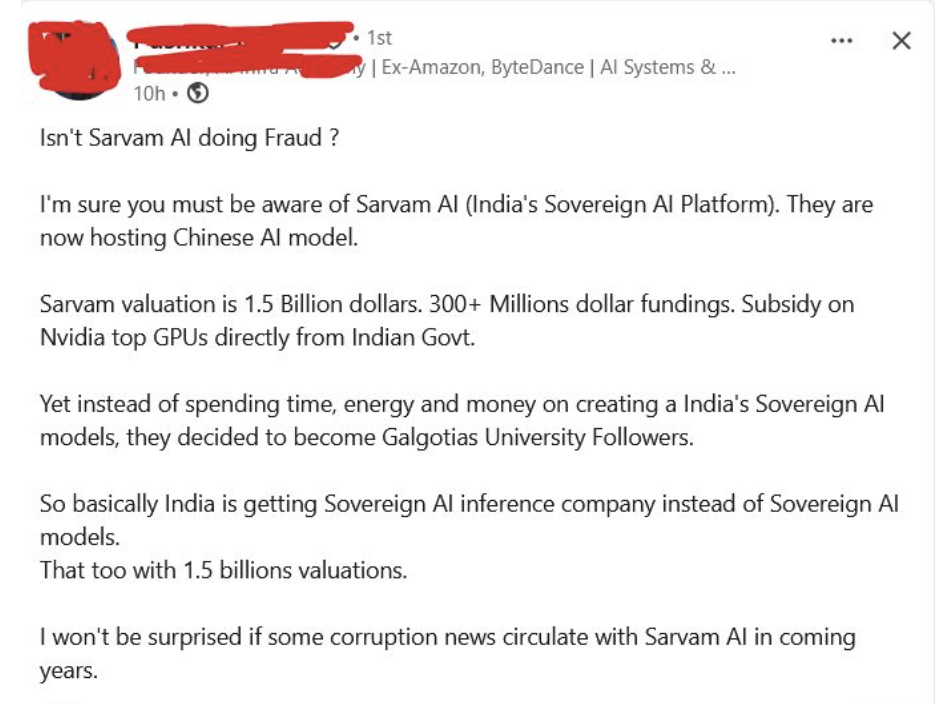
Sarvam launched Token Factory, an inference platform that serves open-weight models from DeepSeek, Moonshot, Zhipu, and Alibaba, alongside its own Sarvam 105B model.
Within days, a company once seen as the face of India's AI ambition found itself accused of reselling Chinese intelligence on taxpayer-funded GPUs.
This supposed fall from grace was striking, but perhaps not entirely unexpected.
Neither is it a fair view of Sarvam.
Here are my thoughts on these developments.
Separating the record from the rumour
Let us start with what is on the record.
Sarvam co-founder Pratyush Kumar has publicly stated that Token Factory operates on GPUs procured privately, and is therefore not running on taxpayer-funded infrastructure. In fact, Sarvam's access to government-provided GPUs had also ended in March 2026.
There are claims to the contrary.
But nobody outside the company can independently audit which workloads ran on which GPU clusters.
My intent is not to pass any judgement to convict or acquit anyone on that basis.
I would only ask that we stop treating an allegation as an established finding.
Once we set the speculation aside, a more interesting question remains: what exactly were we expecting Sarvam to build?
Many of us wanted Sarvam to become India's OpenAI.
There is disappointment that the company has built an inference business instead of focusing exclusively on developing an indigenous frontier model (Sovereign AI, many would say).
I understand that disappointment.
But I think we need to examine whether the expectation itself was ever reasonable.
What do we actually mean by 'Sovereign AI'?
The word sovereign is being used rather loosely in this conversation.
I think it is worth separating a few different ideas.
- Technological sovereignty: Who owns the model, the data, the infrastructure and the intellectual property? Where does the technology reside? Can an external policy decision or geopolitical development suddenly restrict our access to it?
- Economic sovereignty: Can the company building this technology generate enough revenue, attract capital and compete globally to sustain its operations? Or will it remain dependent on government contracts and grants?
- Societal sovereignty: Does technology solve problems that matter to the people and businesses it is supposed to serve? Does it work across our languages, communities and real-world contexts?
These three dimensions do not automatically align.
A model can be developed and hosted in India, with data remaining within the country's boundaries, and still depend on foreign foundational models or hardware.
A company can be commercially successful without building every layer of the technology stack itself.
And does a technically impressive model justify its utility without meaningfully improving the lives of the people it was meant to serve?
So, does Sarvam contribute to sovereignty if it offers access to open-weight models developed elsewhere?
I would say the answer depends on what part of sovereignty we are measuring.
If the objective is to ensure that Indian businesses can access and run models within infrastructure under their control, an inference platform (like Sarvam) can contribute to that objective.
If the objective is to own every layer, from foundational research and model weights to infrastructure, then inference alone is not enough.
These are different ambitions.
We should not confuse them.
Sovereignty is not a single product feature.
It is a capability that an ecosystem builds over time.
A national mission and a commercial business are not the same thing
I learnt this distinction first hand during my previous venture, Reverie Language Technologies.
In 2016, we were working towards a larger goal: making Indian languages accessible on mobile devices.
At the time, language support across mobile manufacturers was inconsistent. Some devices supported certain Indian languages, others did not.
The solution could not be to keep convincing every manufacturer independently.
We worked with the industry and the government to push for a broader mandate.
The objective was to ensure that mobile phones sold in India could display all 22 constitutionally recognised languages and support input in English, Hindi and the language of the region where the device was being sold.
It was the right thing to do.
It advanced language equality at a national level.
But it also meant that something we had built as a commercial offering became part of a broader public mandate. It ate into our revenue.
We understood that trade-off.
The larger mission mattered, and we were willing to contribute to it.
But this brings me to a distinction that I believe we need to make when discussing India's AI ambitions.
A national mission and a commercial business are not the same thing.
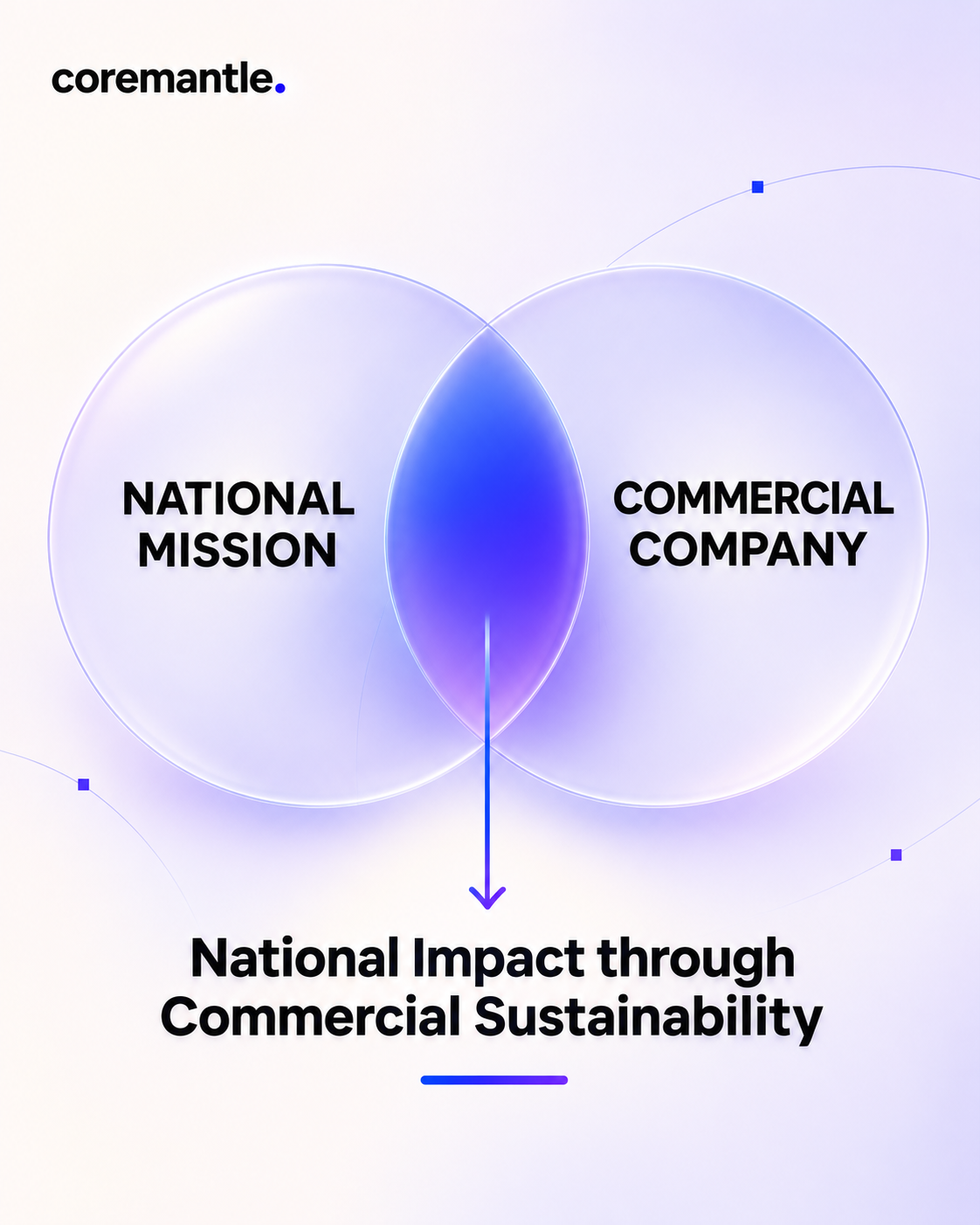
They can work together, but they operate with different objectives.
UPI and PhonePe: how working together but operating with different objectives looks
Consider UPI and PhonePe.
UPI is a public digital infrastructure.
PhonePe is a commercial business built on top of that infrastructure.
One creates the rails; the other builds products and services that people use. Both are important, but they are not expected to operate in the same way.
The same distinction matters in AI.
- A national mission should focus on building capabilities that the country needs: research, infrastructure, datasets, language resources and access to compute.
- A commercial company, meanwhile, has to build products, find customers, generate revenue and eventually deliver returns to its investors.
The two can complement each other.
But expecting one organisation to fulfil both roles without acknowledging the tension between them is unrealistic.
There is another challenge here if a business were to rely entirely on government-backed projects for its sustenance: the way government procurement works.
Majority of the government tenders follow the L1 principle, where the lowest bidder wins, provided the bid meets the prescribed requirements.
That may be appropriate for many procurement categories.
But when we are talking about advanced AI research and infrastructure, we have to ask whether the lowest bid will necessarily deliver the best quality.
Building frontier AI is not the same as procuring a standard technology service.
It requires long-term investment, continuous experimentation and the freedom to pursue research directions that may not produce immediate results.
Which requires Capital.
And the capital required is enormous
In March 2026, OpenAI announced a funding round involving $122 billion in committed capital.
Sarvam, meanwhile, has raised approximately $350 million in disclosed private funding across its funding rounds and subsequent investment. It has also received compute support valued at ₹246.72 crore under the IndiaAI Mission.
The difference in the scale of available capital is still striking.
OpenAI's latest funding commitment alone is roughly 350 times Sarvam's cumulative disclosed private funding.
Now consider what it actually takes to build a frontier model capable of competing with organisations such as OpenAI and Anthropic.
It is not simply about buying GPUs and running one large training exercise.
It requires:
- Sustained access to enormous computing capacity
- The ability to attract and retain some of the best research and engineering talent
- Continuous investment in data, infrastructure and experimentation.
And experimentation means accepting failure.
Some approaches will have to be abandoned, and others will need to be tried repeatedly. This is why frontier AI development needs not just large amounts of capital, but a sustained supply of capital over several years.
This is not to say that we should lower our ambitions as a country.
We should absolutely aspire to build indigenous frontier models.
But we also have to ask what financial and institutional environment we are creating for the organisations expected to build them.
- Can a company compete with organisations that have access to hundreds of billions of dollars in capital while depending primarily on a limited national mission allocation?
- Can it attract the best talent, experiment freely, absorb failures and keep investing in research while simultaneously being expected to deliver immediate commercial returns?
They are questions about the resources and conditions required to succeed.
We have to be realistic and pragmatic about that gap.
And the point is not that public funding should replace private investment, or that commercial companies should be exempt from accountability.
It is that we need to understand what we are asking each institution to do, and give it the right conditions to succeed.
Perhaps the answer, then, is not to measure India's AI ambition against the scale or playbook of Silicon Valley.
It is, in fact, to ask what kind of AI ecosystem India actually needs to build, and where it can create an advantage of its own.
India does not necessarily have to follow the exact playbook of Silicon Valley
I don't believe India's AI future should be measured by how closely we replicate the American model.
We have a tendency to look at the most visible global success stories and assume that the same path is the only path to success.
But why should it be?
The evolution of the automobile industry in India is a good example of understanding country-specific needs.
Not every country needs to build premium cars like a BMW or a Mercedes to develop a strong automobile industry.
Tata, Mahindra, Maruti and Hyundai built products for a different market, at a different price point, with a different understanding of what customers needed. That is what India needed and that is what the majority of India was willing to pay for.
Innovating and building for that demand is not a lesser form of innovation. It is pragmatism.
Similarly, DeepSeek demonstrated that there can be alternative approaches to building capable AI systems.
There is more than one way to create meaningful technological capability.
We also need to be honest about the problems we need to prioritize to solve.
While sending humans to Mars is an extraordinary technological ambition, if a country still needs to provide reliable infrastructure, healthcare, and education, those obviously take precedence over chasing a Mars mission with a singular focus at the expense of understanding the context of what the country needs - more so if there is a choice to be made for funds allocation.
The same applies to AI.
We can aspire to build frontier models.
We should.
But we must also build smaller, specialised models that solve specific problems reliably, economically and within environments that organisations can control.
An enterprise that trains a small model on its own data, deploys it within its premises and keeps its information ring-fenced may have achieved a meaningful form of sovereignty.
It does not need to build a giant language model to make that claim.
Why should sovereignty always have to mean an LLM?
India's research needs to reach the real world
India has no shortage of capable researchers or institutions.
We have IITs, IISc, C-DAC, CIIL, and several other organisations working on important areas of language and technology research.
The question to ask is what happens after the research.
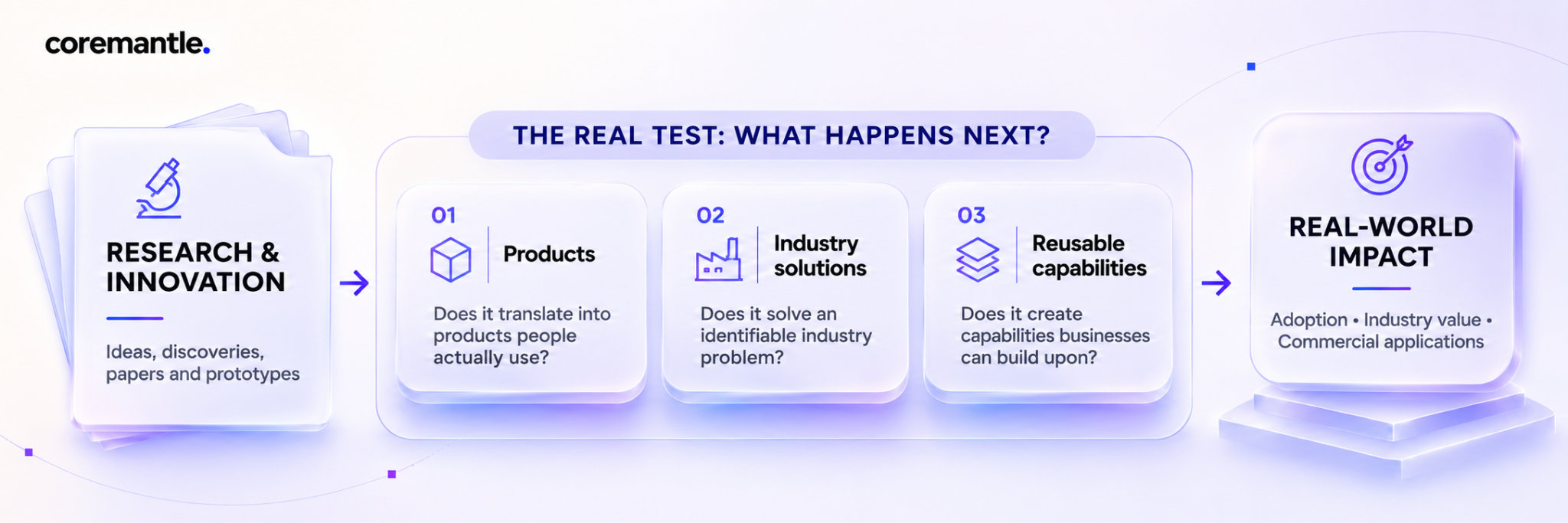
Publishing papers and conducting launches are important parts of research. But they cannot be the only measures of success.
Take cancer research as an example.
The real impact of cancer research lies in whether research is helping detect cancer earlier, improving treatment outcomes or reducing the progression of the disease.
These are meaningful indicators of whether the research is making a difference.
We need similar clarity in technology research.
- Who is the end beneficiary?
- What problem are we trying to solve?
- How will we measure whether the work has succeeded?
Research institutions should have the freedom and funding to pursue foundational work.
But there should also be a pathway for that work to reach industry and society.
Grants should be designed with a clear understanding of the outcomes they are intended to enable.
There is an important distinction here.
Institutions working on mission-critical programmes, such as ISRO, operate in an environment where outcomes are non-negotiable.
A rocket cannot simply be launched as an activity. It has to work.
We need to build stronger bridges between research and real-world outcomes across the rest of our technology ecosystem too.
What should India actually build?
I see three broad layers that need sustained attention.
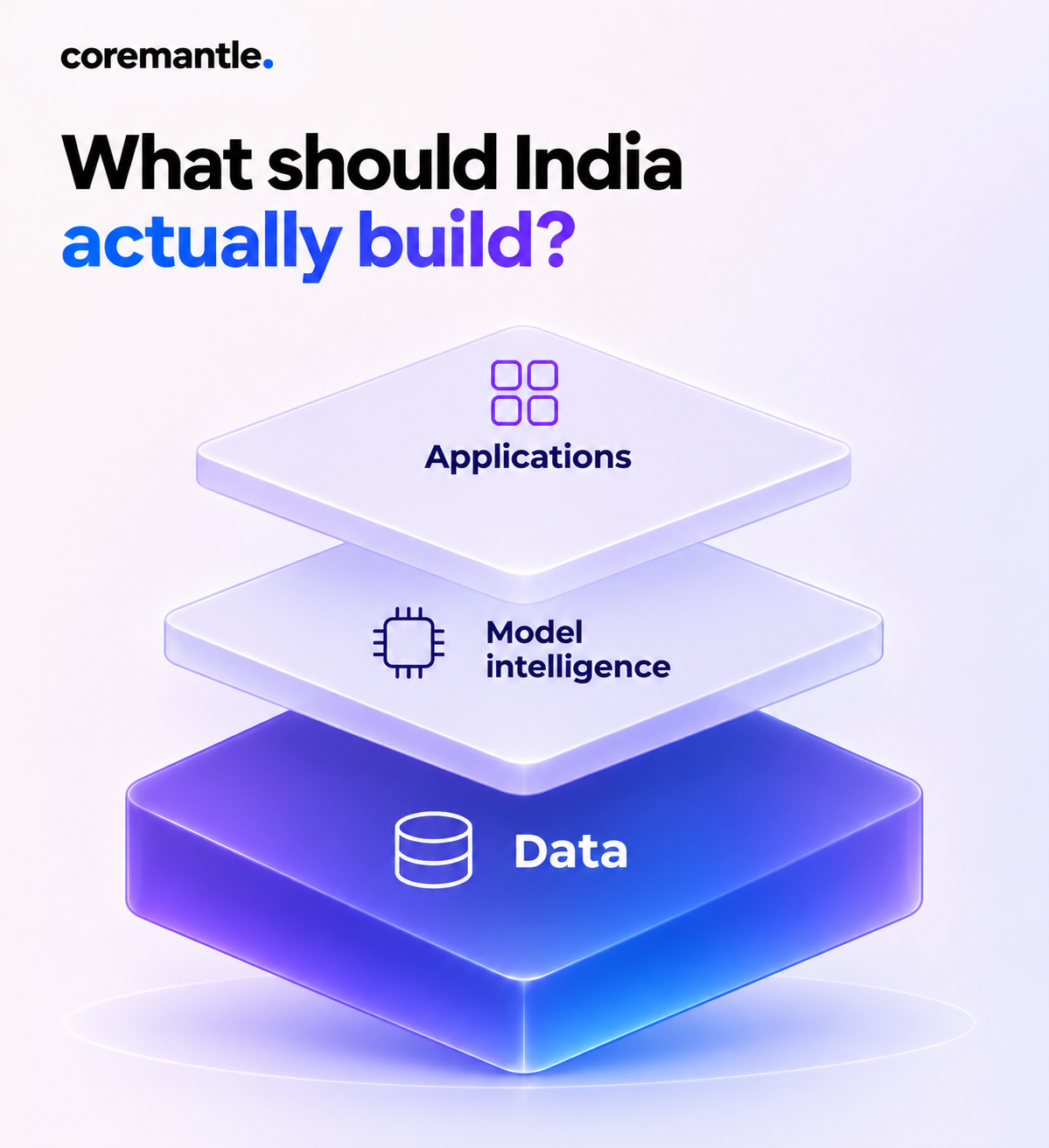
1. Data
High-quality, representative, domain-specific and language-specific data is the foundation. Without it, even capable models will struggle to perform reliably in the contexts where people need them.
2. Model intelligence
We need foundational models, but we also need smaller models trained for specific domains, languages and tasks. The objective should be to build the right intelligence for the problem, not simply the largest model we can announce.
3. Applications
This is where technology meets everyday life.
Consider a simple example.
Even today, someone who wants to write an essay in Odia may have to write it in a notebook and take it to a desktop publishing operator to get it typed and formatted.
We have made progress in speech-to-text and text-to-speech, but there are many basic language tasks that remain unnecessarily difficult.
Can technology make that person independent? Can they write, edit, publish and access information in their own language without needing an intermediary?
That is the kind of outcome we should be measuring.
The objective is not merely to demonstrate that an AI model understands an Indian language. It is to make technology genuinely usable in that language.
Commercial sustainability is not the enemy of a national mission
I want to return to where I started: the difference between a mission and a business.
There is a reason companies have dedicated CSR programmes.
They can invest in social initiatives because their core businesses generate profits.
If a company cannot sustain itself, it cannot keep funding work that may not have an immediate commercial return.
If we cannot put food on the table for ourselves first, where is the opportunity to feed someone else?
Commercial sustainability creates the capacity to pursue a larger purpose.
It does not automatically guarantee the right intention, but without it, that purpose can become difficult to sustain.
This is not an argument for putting commercial interests above national interests.
It is an argument for being honest about what each institution and company is designed to do.
India needs public infrastructure, foundational research, commercially viable technology companies and applications that solve real problems.
These are complementary parts of the same ecosystem. We should not expect one organisation to do everything.
The real measure of India's sovereign AI ambition should not be whether we build another OpenAI. It should be whether we build the capability to own, operate and improve the technology we depend on, and whether that technology solves problems that matter to our people.
That is a much harder ambition.
And a much more meaningful one.